|
|||||
|
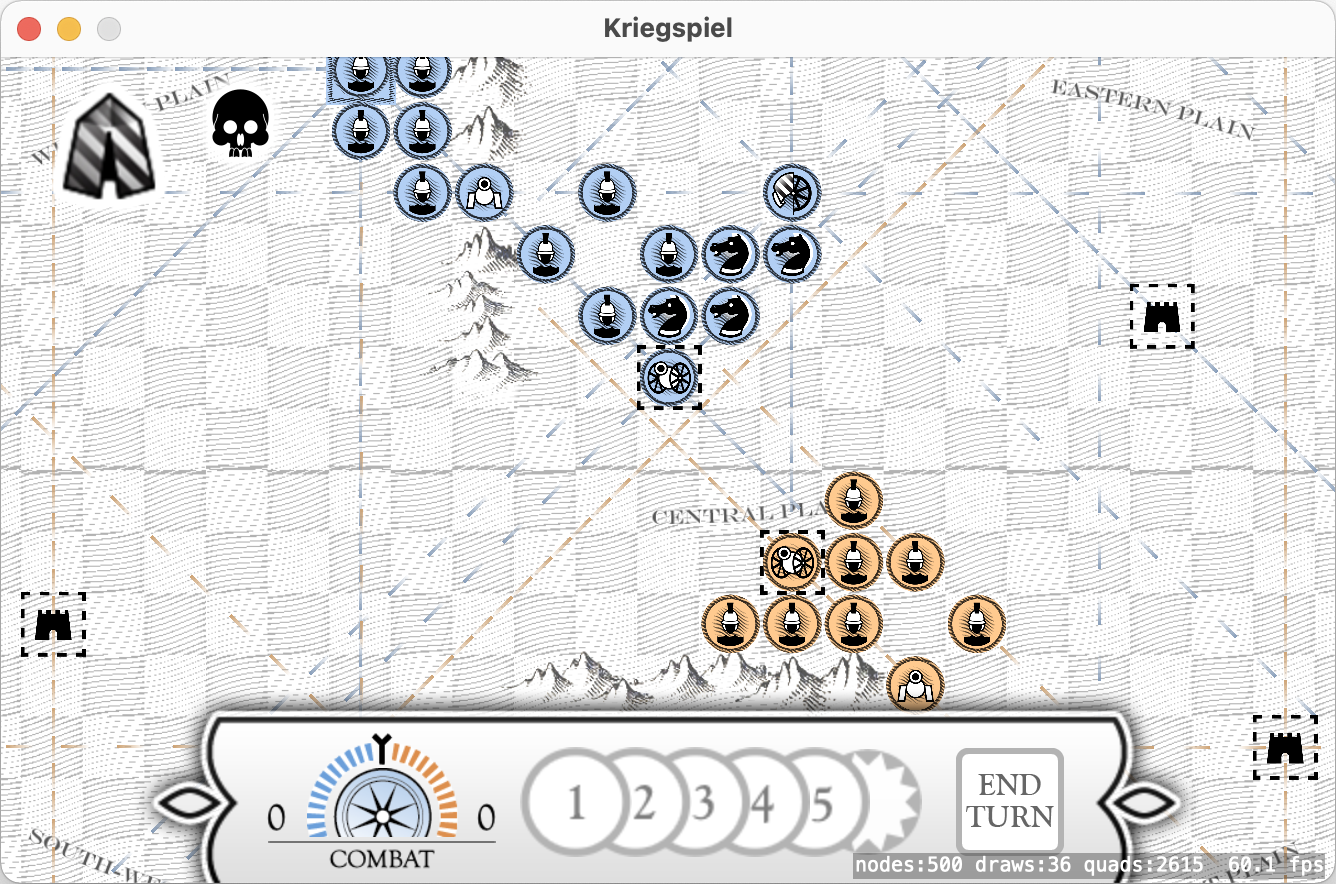
The game is played by two players on a game board of 500 squares arranged in rows of 20 by 25. The board is divided into a northern territory and a southern territory, each with a single mountain range of nine squares, a mountain pass, two arsenals, and three fortresses. ![]() Enlarge
Combat Units Each player has nine infantry, four cavalry, one cannon, and one swift cannon.
Communication Units Arsenals radiate lines of communication vertically, horizontally, and diagonally. In addition, relay units propagate any line of communication aimed at them. Each player has one relay, and one swift relay.
All units must remain in direct connection with their own lines of communication, or be adjacent to a friendly unit in communication. If not, the unit goes offline and becomes inert. Units are free to move out of communicative range, but once offline they may not move, attack, or defend themselves. (However any nearby friendly units will still lend their defense to offline units.) Relay units are an exception: they may move freely in and out of communication, yet will only relay the arsenal's signal if in direct line of sight. Lines of communication are blocked by mountains and by enemy units. However communication passes freely through mountain passes and is not blocked by enemy transmission units. Start Game Before the match, each player positions its units freely within its own territory. The starting positions of the opponent are not known until the game begins. A roll of the dice determines who moves first. Movement & Attack The game proceeds in turns. A player may move up to five units each turn, followed by a single attack against an enemy unit. Moving fewer than five units is allowed, and the attack is not obligatory. Movement range varies per unit type. No single unit can move more than once per turn.
An attack is determined by summing all the offensive power in range of an enemy target square, then subtracting this number from a summation of all the defensive power supporting the same target square. Offensive and defensive power emanates from a unit in a straight line, either vertically, horizontally, or diagonally.
The following diagram explains how combat works in the game. Consider the southern cavalry at position "A." The northern cavalry charge at position "B" aims 14 attack points against "A." The northern cannon and infantry also contribute attack power, totaling 23 cumulative points for the north. The south's defense is a summation of all pieces in range of position "A." The southern cavalry defends itself for 5 points, and receives help from two other pieces for a total of 19. Note that the unit at position "C" does not contribute any defense because it is not in a direct line (horizontal or diagonal) with the southern cavalry at position "A." Since 23 is greater than 19, north may attack the cavalry at position "A." ![]() If the offensive power is less than or equal to the defensive power, the unit is safe. If the offensive power is two or more, the unit is attackable. If the offensive power is 1 point greater, the vulnerable unit resists but can be put into a forced retreat. With a forced retreat, the defender is obligated to move the unit at the commencement of its next turn. The retreating piece is also excluded from offensive combat in that turn. If there is no open square available for retreat, the unit is destroyed.
Special Considerations Only one unit at a time may occupy an arsenal, fortress, mountain pass, or other square. Fortresses are not allied with a faction and can be occupied by any unit from either side. Fortresses do not propagate communication and cannot be destroyed. An arsenal is destroyed if it is occupied by the enemy. Only empty arsenals can be occupied. The destruction of an enemy's arsenal counts as an attack, and no other attack may be deployed that turn. Note: Relay units have no offensive power and thus cannot destroy an arsenal. Cavalry can not charge against a fortress or mountain pass; any cavalry currently occupying a fortress can not participate in a charge (although charging while in a pass is allowed). How to Win A player wins by destroying the enemy. There are three ways to do this: (A) Destroy the enemy's two arsenals (B) Destroy all enemy combat units (C) Destroy the enemy's two relays and force all remaining units offline Alternately if both sides agree to quit, the game is a draw. | |||||||||||||||||||||||||||||||||||||||||||||||||||||||||||||||||||||||||||||||||||||||||||